




Introduction
An interesting question for civil engineers today is how adapt to climate change, and in particular how to estimate forcings for civil structures and infrastructures in the presence of climate change. The problem is not an easy one, as there are still considerable uncertainties about the future trends of climate. Engineers also have to provide practical and financial evidence about projects and their sustainability, in order to provide effective solutions.
Civil engineers are responsible for the planning, design, construction, operation and maintenance of infrastructures including buildings, communication facilities, energy generation and distribution, and so forth. Engineers also bear the responsibility for their project during their entire design lifetime, which may be extended to hundred of years. Therefore, the evaluation of the way future climate will evolve is of paramount importance, as climate drives several forcings for civil infrastructures.
Forcings that may be influenced by climate and are relevant to civil engineering are:
- Extreme precipitation, driving flood risk, that in turn is relevant to several sectors of civil engineering;
- Precipitation scarcity, driving droughts;
- Extreme wind and snow, driving forcings on infrastructures;
- Hurricanes, that are relevant to coastal flooding and transportation;
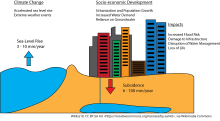
- Extreme waves, relevant for offshore infrastructure design and coastal flooding (see Figure 1);
- Heat waves, that are relevant for the design of technical equipment.
It is debated the influence of climate on seismicity, through the impact on groundwater levels. Also, climate has an impact on many socio-economic forcings. However, these latter impacts are less relevant with respect to the bullet list indicated above.

Figure 1. Drivers of sinking cities. By Wbliss10, CC BY-SA 4.0, https://creativecommons.org/licenses/by-sa/4.0, via Wikimedia Commons
References
The Committee on Adaptation to a Changing Climate of the American Society of Civil Engineers was formed in 2011 to evaluate the technical requirements and civil engineering challenges for adapting to a changing climate. Since then, the committee carefully assessed recent research advances with the purpose of translating findings and understanding of climate change into technical recommendation. A significant output is Adapting Infrastructure and Civil Engineering Practice to a Changing Climate, a report that presents an accurate discussion of the potential significance of climate change to engineering practice.
A summary of the report is presented in these slides, which provide an excellent starting point for the discussion. Here is a version with my notes.
To be completed.
- 206 views